Watch Your Order Come to Life: The Living Art of the Deli Counter
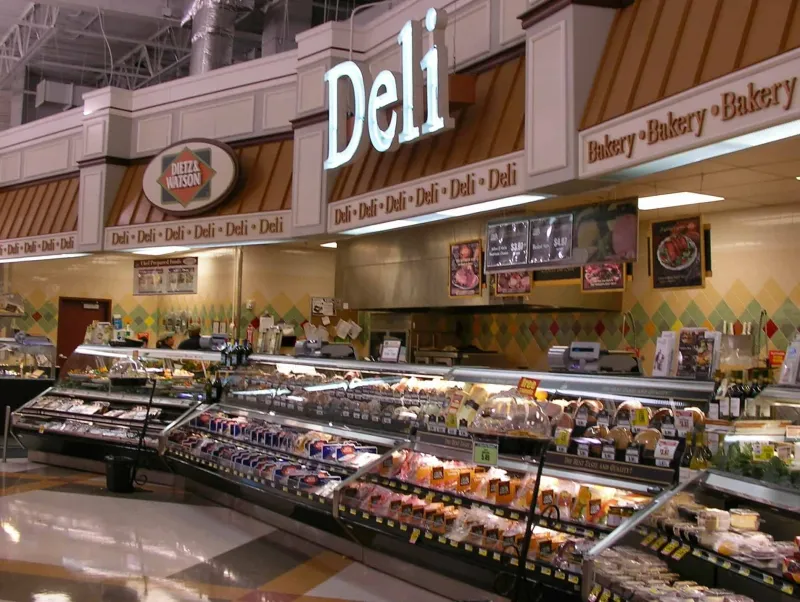
Photo: deli worker slicing meat behind counter customers watching, via roma044.github.io
You've been standing in line for maybe four minutes. Ahead of you, someone's ordering a hot pastrami on rye with mustard and pickles. You're not even hungry for pastrami — you came in for the turkey club — but you can't look away. The person behind the counter moves with a kind of easy authority: one smooth pull of the slicer handle, a fan of thin-cut meat landing perfectly on the bread, a quick read of the customer's expression before asking, extra mustard? It's over in under two minutes, but it felt like watching someone do something they were genuinely born to do.
That experience — the watching, the witnessing — is something the deli world has always understood instinctively. And it turns out there's a lot more going on behind that glass case than most of us ever stop to appreciate.
The Counter as Stage
Walk into almost any neighborhood deli and you'll notice the layout follows a kind of unspoken logic. The prep happens right in front of you. The slicer gleams under the overhead lights. The bread boards are wiped clean and ready. Nothing is hidden, nothing is mysterious — and that's entirely the point.
"People want to see what they're getting," says a longtime counter worker at a busy Chicago deli who's been slicing meat for going on eighteen years. "When you're behind the counter, you're not just making food. You're showing someone that you care about what you're handing them. That's a different thing."
It really is a different thing. The open-kitchen model — which fine dining restaurants have spent the last decade trying to replicate with elaborate chef's counter experiences — has been standard operating procedure at neighborhood delis for generations. There's no curtain, no mystery box. What you see is exactly what you get, and the person making your sandwich knows you're watching.
That visibility creates a kind of accountability that's almost impossible to manufacture in a hidden kitchen. When you're slicing turkey behind closed doors, nobody notices if you go a little heavy on the gristle or stack the bread unevenly. When you're doing it six feet from a customer who's been coming in every Tuesday for a decade, you notice. You always notice.
Reading the Room — and the Regular
One of the most underappreciated skills in the deli business is the ability to read a customer before they even finish their sentence. Veteran counter workers develop what some of them describe as a kind of intuition — a feel for what someone actually wants versus what they're saying out loud.
"You get to know people," explains a deli owner who's run her family's counter in a Philadelphia neighborhood for over twenty years. "Someone comes in and they look tired, they're not saying much — I already know they want the comfort order. The thing they always get when they've had a rough week. I don't ask. I just start making it."
That kind of attentiveness is what separates a great deli from a merely functional sandwich shop. It's not just about knife skills or portion sizes — though those matter enormously — it's about the accumulation of small observations that turn a transaction into a relationship.
The physical craft itself is no small thing either. Slicing deli meat to the right thickness for a given sandwich is a skill that takes real time to develop. Too thin and the meat loses its presence, turning into a kind of papery filler. Too thick and the sandwich becomes a jaw workout. The sweet spot — that perfect, slightly yielding slice that holds together without dominating — is something the best counter workers hit almost automatically, adjusting on the fly based on the cut of meat, the bread choice, and the customer's stated preferences.
The Assembly Ritual
Watch closely the next time you're at a good deli counter and you'll start to notice the ritual quality of sandwich assembly. There's an order to things that isn't arbitrary. Bread goes down, condiments spread to the edges (not the middle — that's amateur hour), proteins layered with attention to height and balance, vegetables added for texture and color, everything finished with a press of the hand that's less about compression and more about intention.
"A sandwich that looks good tastes better," one New York deli veteran says flatly. "I don't know why that's true, but it's true. When you hand someone something that looks like you meant it, they eat it differently."
There's actual psychology behind this. Research on food presentation consistently shows that visual appeal shapes flavor perception — we taste with our eyes before our mouths ever get involved. The deli counter, with its theatrical assembly process, is essentially staging a small performance designed to prime your appetite before the first bite.
Why Hidden Kitchens Can't Compete
Chain sandwich operations figured out a long time ago that standardization is efficient. Portioning is done in advance, assembly follows a laminated diagram, and speed is the primary metric of success. None of that is inherently wrong — but it strips out everything that makes the deli counter experience meaningful.
When your sandwich disappears through a window and comes back in a wrapper, you have no idea what happened to it. You have no relationship with the person who made it. There's no theater, no accountability, no sense that anyone on the other side of the transaction gave a single thought to whether you'd enjoy what they handed you.
The neighborhood deli — places like what we celebrate here at M&M Deli — operates on a completely different premise. The counter is a shared space. It belongs to the worker and the customer equally. What happens there is a small, daily negotiation between two people about what a good sandwich looks and tastes like, and that negotiation builds something over time that no chain operation can buy or replicate.
Come for the Sandwich, Stay for the Show
Next time you're at your local deli, give yourself permission to slow down and watch. Don't stare at your phone while your order gets made. Notice how the slicer is set, how the layers go down, how the person behind the counter handles the bread. You might be surprised how much you learn — and how much better the sandwich tastes when you've watched every step of it come together.
The deli counter isn't just a place to pick up lunch. It's one of the few remaining spots in American daily life where skilled craft happens right in front of you, without pretension, without a reservation, and without a markup for the privilege of watching. That's worth something. That's worth showing up for.